
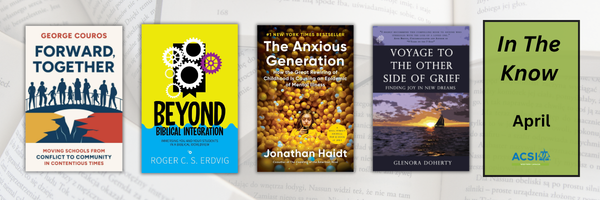
Some of us are striving to move beyond our current limits while others are being held back. Either way, you will find something with this month's recommendations. — Dr. Christian Klaue
-
Forward Together - George Couros
What is this resource about? Couros wrote this book to encourage school administrators to work together so that, together, they could help the school fulfill its vision and mission. Couros described six key principles and six perspectives to not lose sight of in that process. These principles include the importance of elevating others, building community, and ensuring that others feel valued. Some of the perspectives Couros highlighted included the importance of listening, not needing others to always life you up, and elevating others by using intentional language to do so.
Why is it important? While many Christian schools only have one administrator, especially the smaller ones, that does not mean that one person can do all the work. So, how does the work get accomplished if there is only one official leader? That is where this book comes in. Everyone needs a team to help them and keeping the various principles and perspectives in mind will help the administrator work effectively with others to meet their mandate.
What should I do? Pull together you team and then read this book together. Stop at the end of each chapter and discuss and reflect on what was read and make a plan for implementation before moving on to the next chapter.
-
Beyond Biblical Integration - Roger C.S. Erdvig
What is this resource about? Erdvig describes the current pattern of biblical worldview integration found in many Christian schools and explains how develop your own worldview so that you can effectively teach others what your worldview is. However, he doesn’t stop with that concept. He goes on to explain that merely conveying a biblical worldview cognitively will not help a student actually develop his/her own biblical worldview. The missing ingredient is that a student needs to actually desire to develop a biblical worldview. Once a student wants a biblical worldview, the teacher’s instruction becomes effective.
Why is it important? Christian school teachers spend much time trying to instill a biblical worldview. Our efforts have not all been fruitful. If there is a way to be more effective, then that is something we need to try. Following Erdvig’s guidelines will help us be more effective in discipling students who have a biblical worldview.
What should I do? Review Part 1 to ensure that you have a clearly defined biblical worldview before moving to Part 2 and learning how to be effective in the actual discipleship process of students.
-
The Anxious Generation - Jonathan Haidt
What is this resource about? Haidt describes the rise of anxiety within society, posits some reasons for why this might be happening and then seeks to provide some solutions to this problem. While digital devices and social media feature prominently as reasons for why anxiety is rising, he embeds that into the larger picture of the need for physical risk instead of virtual risk.
Why is it important? Anxiety truly is an epidemic and the reasons are not always as simplistic as they seem. And yet, because our children are struggling in this area, we have a responsibility to see how we can help our own children in dealing with these problems. The first step would be to determine to what extent our own children are caught up in this issue before we seek to help them through these practices into a more flourishing life.
What should I do? Become familiar with the issues, through reading this book and others like it such as Sherry Turkle’s Reclaiming Conversation and Jean Twenge’s iGen. Then, conduct an internal audit to determine the extent to which you are contributing to the problem. Finally, make the changes needed in your own life before asking your children to follow suit. Being a good role model is a far better approach than just telling someone what to do.
-
Voyage to the Other Side of Grief - Glenora Doherty
Who is this resource about? One of my cousins died a few months ago at a young age, leaving her family in shock. A few months later, another cousin died for no discernable reason. When I saw this book on my shelf, I thought it might be good to read this and get an idea of how someone else processed the grief of losing a loved one at a relatively young age. The author of this biography lost her 62-year old husband to a heart attack. It was unexpected, as he had just come through successful heart surgery six days previous. This book chronicles the next number of years as she documents how she went through the seven stages of grief. Her emotional journey through grief connected to her spiritual journey as it was also a journey reconnecting with her faith.
How can I pray? There are many who have lost a loved one. Loneliness is a significant struggle for many survivors. Praying for those who have lost a loved one, and then combining that with the practical steps of inviting them to spend time with you, is a great way to encourage them.