
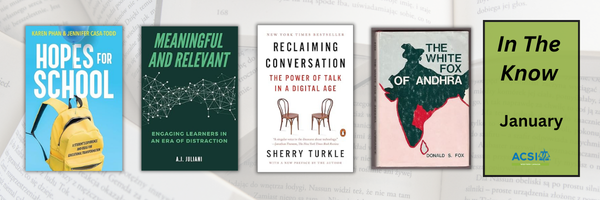
The theme for this month is hope. Hope is the expectation of something better that will come to pass. See how this applies to the following four books. — Dr. Christian Klaue
-
Hopes for School - Karen Phan and Jennifer Casa-Todd
What is this resource about? George Couros has written several books and produces a regular podcast. One of his readers, a high school student, commented on something he said and Couros invited her to put her thoughts into a book. The student, Karen Phan, was then connected to a teacher, Jennifer Casa-Todd, who then commented on Phans’ recommendations for improving school. Phan’s recommendations for improving school are: allow for mistakes, move from summative to more formative assessment, improve connections within schools, address the homework load, make school more practical, and give students more voice, choice, and agency. Casa-Todd then provides a rebuttal or comment to round out the suggestions.
Why is it important? Most books dealing with educational improvements have been written by educators (adults). This is the first book I have come across that was mainly written by a student. The perspective she shares is valid for many Canadian schools as well (public and Christian). It is worth talking to our students to see what their impression of school is as they are the ones who are experiencing ‘school’ more than the parents. Of course those conversations need to be filtered (there are some concepts that need to be taught even if students are not always excited by it).
What should I do? Sit down and listen to the voice of a student on how schools can become more student-friendly and still when it comes to student learning.
-
Meaningful and Relevant - A.J. Juliani
What is this resource about? Juliani addresses student engagement and how that can be improved. As he states in the title, school work should be more meaningful and relevant to students. ( I get it, but we still have to teach the curriculum). Juliani offers a variety of suggestions on how to make this happen in the average classroom.
Why is it important? We live in a world that fosters distraction. Attention spans are decreas (That is not a typo; that is an example of a shortening of our attention spans). How can we increase student engagement in our classrooms without having to relearn or restructure everything that we do? We want students to care about their learning as students need to take ownership of their own learning. Any strategies we can obtain to help make students want to learn deserve attention.
What should I do? While there is a flow to the book, it is also possible to only consider a chapter that appears relevant to your situation right now. I enjoy reading Juliani as it is obvious he cares about students, student learning, and helping teachers help students learn more effectively.
-
Reclaiming Conversation - Sherry Turkle
What is this resource about? Turkle describes the impact that digital devices have on the ability to carry a conversation. Her research has shown that the more time people spend on their devices, the lower their ability to carry a conversation and the lower their ability to show empathy to others.
Why is it important? A conversation is becoming a lost art. People spend more time on their phones and, as a result, they spend less time talking. There are many today who prefer a text to a phone call so that they don’t have to talk. A conversation improves the ability to discuss a topic, develop patience as they wait for the response, display empathy as they have to try to understand where the other person is coming from, and open up many new topics of conversation.
What should I do? Practice putting the phone down and talking to others around you. Try to have family time in the evenings where no one reaches for their phone. The more time spent away from a digital device, the greater the opportunity to expand your thinking and your ability to converse.
-
The White Fox of Andhra - Donald S. Fox
Who is this resource about? This is the biography of Silas Fox who ended up as a missionary to India. What makes this story interesting is that Silas did NOT want to become a missionary. If he would be willing, he knew that God would send him to India and Silas did not like curry. Eventually he followed God’s leading, just like Jonah, and decided that he would become a missionary. Of course God directed him to India. Years later, when he was back in Canada on furlough, he cut his visit short as he could not wait to get back to India to eat more curry. He was very open about being a missionary, much to the chagrin of his children, as they did not always enjoy being so conspicuous. Although I never met Donald Fox, I had the privilege of spending time with two of his children as I attended the same church they did.
How can I pray? We are sometimes afraid to be willing to go where God leads us as we often fear that he will take us overseas to a place we do not want to go. This is exactly what happened to Donald. And yet, he experienced blessing upon blessing through his obedience to God. Pray that you will.